

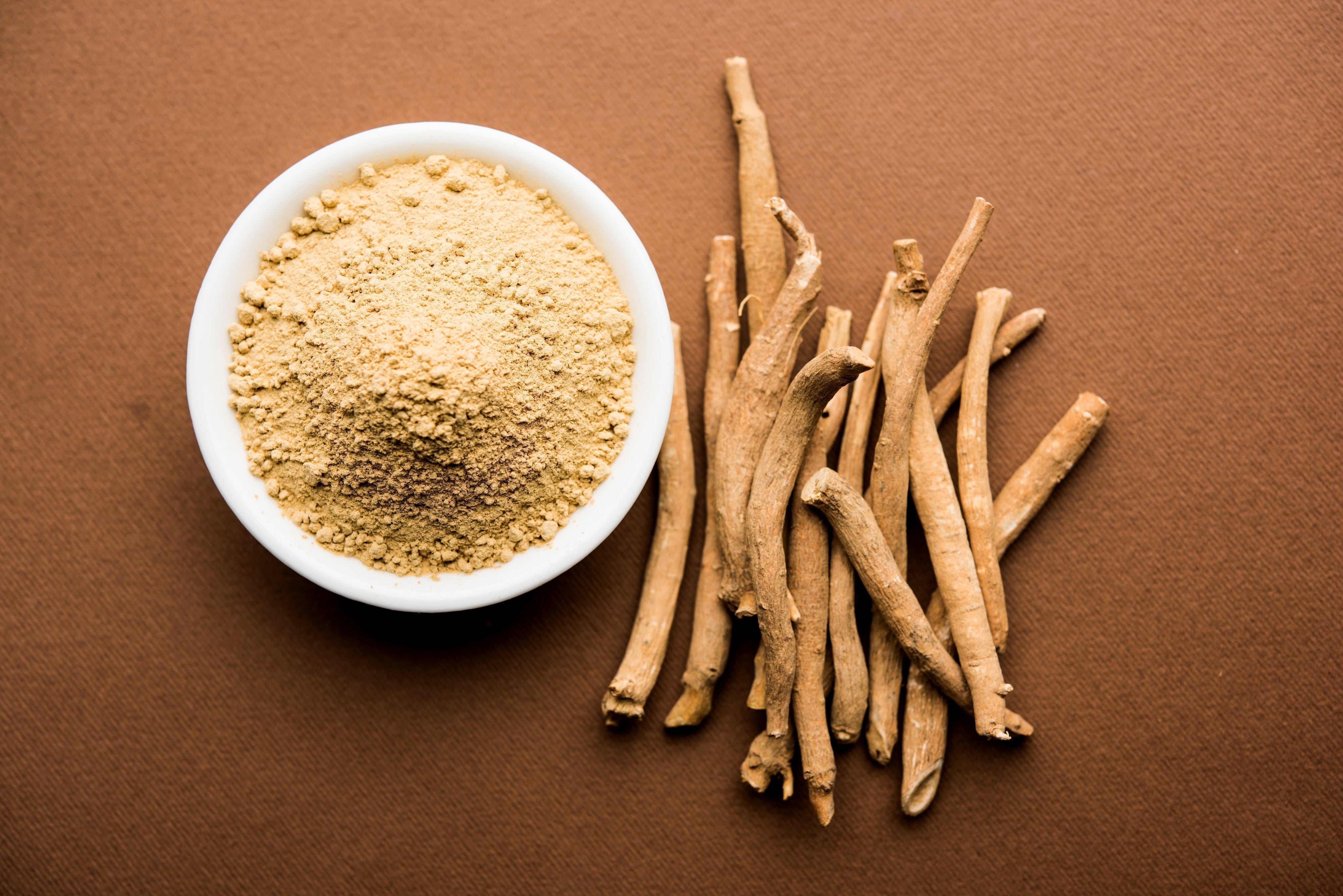
Imagine, a single plant has captivated scientists worldwide for over 5,000 years. What is documented in Ayurvedic texts is now the subject of modern research: Ashwagandha. This traditional root has demonstrated interesting properties in scientific studies. The result is Ashwagandha KSM-66 , a patented extract that has been studied in over 24 clinical trials.
In this article you will learn more about:
- What is Ashwagandha KSM-66?
- Why is KSM-66 so special?
- How is Ashwagandha KSM-66 produced?
- What do scientific studies show?
- Ashwagandha KSM-66 Capsules: A modern way of supplementing
- Dosage and application
- Conclusion
- Frequently Asked Questions
- Scientific sources
1. What is Ashwagandha KSM-66?
Ashwagandha KSM-66 is an innovative raw material extracted from the root of the Withania somnifera plant. This natural source contains a unique combination of withanolides and bioactive plant compounds. Due to this composition, KSM-66 is increasingly used in high-quality dietary supplements.

The plant originates from the arid regions of India and was mentioned in traditional Ayurvedic texts over 5,000 years ago (2). The name "Ashwagandha" comes from Sanskrit and means "smell of the horse," a term that refers to the characteristic, earthy scent of the root.
In Ayurvedic medicine, Ashwagandha is classified as a "Rasayana," a category of medicinal plants known for their properties (2). Ashwagandha contains over 35 different chemical compounds, with withanolides considered the most important bioactive substances (3).
2. Why is KSM-66 so special?
Compared to conventional Ashwagandha extracts, Ashwagandha KSM-66 offers some key advantages because it is a holistic root extract of the traditional plant Withania somnifera and is obtained exclusively from root extract , which contains the highest concentration of active ingredients (4).
It is standardized to 5% withanolides for consistent active ingredient concentrations (1). The chemical-free extraction is based on the principles of "green chemistry" without chemical solvents (5).
3. How is Ashwagandha KSM-66 produced?
The manufacturing process of KSM-66 is technologically advanced and based on gentle extraction methods to preserve the bioactive components (5). First, only Ashwagandha roots that meet specific quality criteria are selected (4). This is followed by a chemical-free extraction process using modern methods that use only water and natural substances (5). In the final step, the final product is standardized to 5% withanolides and tested for purity to ensure consistent quality (1).
4. What do scientific studies show about the effects of Ashwagandha KSM-66?
The properties of Ashwagandha KSM-66 have been studied in numerous clinical studies (6). As a natural adaptogen, it has demonstrated various interesting effects in scientific studies (7).
Studies on stress
A randomized, double-blind, placebo-controlled study by Chandrasekhar et al. (2012) with 64 participants investigated the effects of ashwagandha on stress. Participants received 500 mg of KSM-66 daily for 60 days. The study showed a 27.9% reduction in cortisol levels compared to the placebo group (8).

Another study by Salve et al. (2019) with 58 participants confirmed these results and showed improvements in standardized stress rating scales (9).
Studies on sleep quality
Langade et al. (2019) conducted a double-blind, randomized, placebo-controlled study with 60 participants suffering from sleep problems. Half of the subjects received 500 mg of KSM-66 daily for 10 weeks. The study showed a 29% reduction in sleep onset time (10).
Deshpande et al. (2020) confirmed these results in a study of 150 healthy adults and documented improved sleep quality (11).
Studies on physical performance
Wankhede et al. (2015) investigated the effects of ashwagandha on muscle strength and mass. In this randomized controlled trial, 57 untrained men received either 500 mg of KSM-66 daily or a placebo for 8 weeks, combined with resistance training. The KSM-66 group showed increases in muscle mass (+1.4 kg vs. +0.44 kg) (12).
Further studies by Ahmad et al. (2010) and Gopal et al. (2021) investigated gender-specific effects in men and women (13, 14).
5. Why Ashwagandha KSM-66 capsules as a dosage form?
Ashwagandha KSM-66 capsules offer several practical advantages over other dosage forms. The capsule form allows for convenient ingestion without the need for laborious mixing or dissolving of powders. The precise dosage is particularly advantageous, as each capsule contains precisely 500 mg of KSM-66 extract with 25 mg of withanolides.

Modern formulations often combine ashwagandha extract with supplemental minerals such as magnesium bisglycinate and zinc bisglycinate. This combination makes sense, as zinc contributes to the protection of cells from oxidative stress , and magnesium supports various bodily functions (16).
Vegetable capsule shells made of hydroxypropylmethylcellulose ensure good tolerability and make the supplement suitable for vegans. A pack size of 180 capsules corresponds to a practical 3-month supply at the recommended daily dose, which corresponds to the duration of the longest safety studies.
The capsule form does not compromise bioavailability , while at the same time avoiding the characteristic earthy taste of Ashwagandha root.
6. Ashwagandha KSM-66 Dosage and Application
Scientific research has shown that 500 mg of KSM-66 daily is the optimal dosage (8, 9, 10). One daily capsule containing this amount corresponds exactly to the amounts used in research.
Recommended intake : Take one capsule daily, whole, with plenty of liquid. Research suggests that taking it in the morning is particularly suitable. However, for better tolerability, it can also be taken with meals.
Initial changes can be observed after just 1-2 weeks , while full effects usually become apparent after 4-6 weeks . For optimal results , continuous use for 3-6 months is recommended, which corresponds to the longest safety studies (15).
7. Conclusion
Ashwagandha KSM-66 is an exciting innovation in the field of adaptogens (7). The combination of traditional knowledge and modern science makes it a valuable ingredient in dietary supplements (2). Consumers seeking a scientifically studied alternative to conventional ashwagandha products should consider this innovative extract.
Extensive research with over 24 clinical studies (6) and the chemical-free manufacturing process (5) make KSM-66 a well-documented raw material for modern dietary supplements. However, a balanced diet should always be a priority.
8. Frequently Asked Questions
How long does it take for Ashwagandha KSM-66 to work?
Based on clinical studies, initial effects can be observed after just 1-2 weeks, but study results were usually evident after 4-6 weeks of regular use.
What dosage is optimal?
Most clinical studies used 500 mg of KSM-66 daily. A daily 500 mg capsule corresponds to this evidence-based range.
When is the best time to take it?
Most studies used morning administration. Taking the drug with meals may improve tolerability.
Is Ashwagandha KSM-66 suitable for vegans?
Yes, high-quality products use plant-based capsule shells made from hydroxypropylmethylcellulose and are completely vegan.
How long should I take Ashwagandha KSM-66?
The longest safety studies lasted 6 months of continuous use (15). Continuous use for 3-6 months is consistent with the studies conducted.
What is contained in the capsules?
One high-quality capsule contains 500mg KSM-66 Ashwagandha root extract (5% withanolides), magnesium bisglycinate, zinc bisglycinate and a vegetable capsule shell.
9. Scientific sources
(1) Raut, AA, et al. (2012). Exploratory study to evaluate tolerability, safety, and activity of Ashwagandha (Withania somnifera) in healthy volunteers. Journal of Ayurveda and Integrative Medicine, 3(3), 111-114.
(2) Singh, N., et al. (2011). An overview on ashwagandha: a Rasayana (rejuvenator) of Ayurveda. African Journal of Traditional, Complementary and Alternative Medicines, 8(5S), 208-213.
(3) Mishra, LC, et al. (2000). Scientific basis for the therapeutic use of Withania somnifera (ashwagandha): a review. Alternative Medicine Review, 5(4), 334-346.
(4) Ixoreal Biomed Inc. (2021). Clinical Studies on KSM-66 Ashwagandha. Research documentation.
(5) Kurapati, K.R., et al. (2012). Ashwagandha (Withania somnifera) reverses β-amyloid1-42 induced toxicity in human neuronal cells. Plus One, 7(2), e31894.
(6) Pratte, MA, et al. (2014). An alternative treatment for anxiety: a systematic review of human trial results reported for the Ayurvedic herb ashwagandha (Withania somnifera). Journal of Alternative and Complementary Medicine, 20(12), 901-908.
(7) Panossian, A., & Wikman, G. (2010). Effects of adaptogens on the central nervous system and the molecular mechanisms associated with their stress-protective activity. Pharmaceuticals, 3(1), 188-224.
(8) Chandrasekhar, K., et al. (2012). A prospective, randomized double-blind, placebo-controlled study of safety and efficacy of a high-concentration full-spectrum extract of ashwagandha root in reducing stress and anxiety in adults. Indian Journal of Medical Research, 136(6), 94-99.
(9) Salve, J., et al. (2019). Adaptogenic and anxiolytic effects of ashwagandha root extract in healthy adults: a double-blind, randomized, placebo-controlled clinical study. Cureus, 11(12), e6466.
(10) Langade, D., et al. (2019). Efficacy and safety of ashwagandha (Withania somnifera) root extract in insomnia and anxiety: a double-blind, randomized, placebo-controlled study. Cureus, 11(9), e5797.
(11) Deshpande, A., et al. (2020). A randomized, double-blind, placebo-controlled study to evaluate the effects of ashwagandha (Withania somnifera) extract on sleep quality in healthy adults. Sleep Medicine, 72, 28-36.
(12) Wankhede, S., et al. (2015). Examining the effect of Withania somnifera supplementation on muscle strength and mass: a randomized controlled trial. Journal of the International Society of Sports Nutrition, 12, 43.
(13) Ahmad, MK, et al. (2010). Withania somnifera improves semen quality by regulating reproductive hormone levels and oxidative stress in seminal plasma of infertile males. Fertility and Sterility, 94(3), 989-996.
(14) Gopal, S., et al. (2021). Effect of an ashwagandha (Withania somnifera) root extract on climacteric symptoms in women during perimenopause: a randomized, double-blind, placebo-controlled study. Journal of Obstetrics and Gynecology Research, 47(12), 4414-4425.
(15) Raut, A., et al. (2012). Exploratory study to evaluate tolerability, safety, and activity of Ashwagandha (Withania somnifera) in healthy volunteers. Journal of Ayurveda and Integrative Medicine, 3(3), 111-114.
(16) Choudhary, D., et al. (2017). Efficacy and safety of ashwagandha (Withania somnifera (L.) Dunal) root extract in improving memory and cognitive functions. Journal of Dietary Supplements, 14(6), 599-612.


